# Reference band

Reference bands depict a range of values rather than just a single point (as reference lines do). This is particularly useful when the data can vary within a certain expected range, such as target ranges for performance metrics.

Let's look at how to configure reference bands in Analytics+.

#### 1. Position

Plot the reference band horizontally (start and end on the y-axis) or vertically (start and end on the x-axis).

<figure><img src="/files/UJ9nReZXURwuhtE54G0J" alt=""><figcaption><p>Reference band position</p></figcaption></figure>

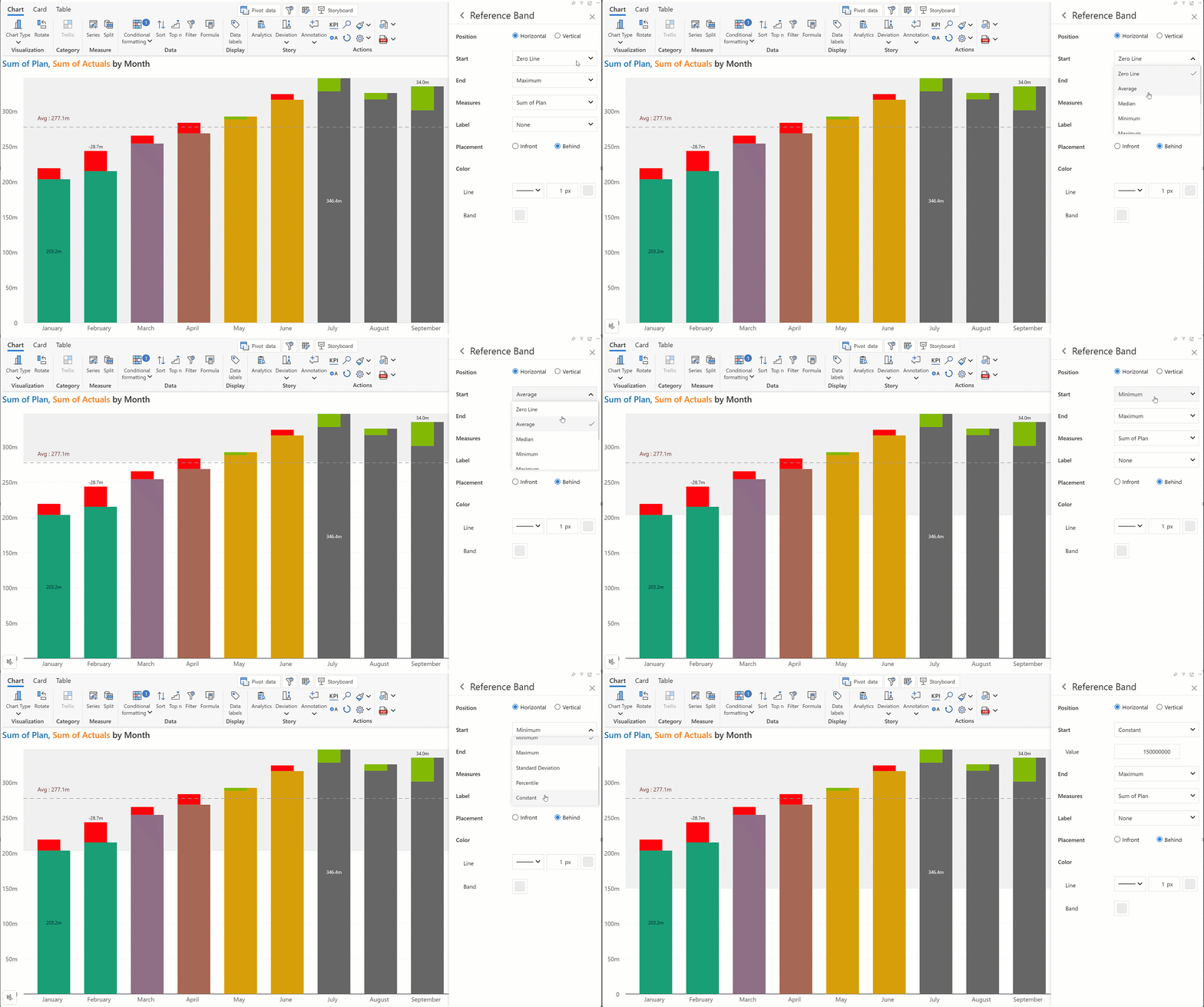
#### 2. Start

Configure the starting point from where to plot the reference band. It can start from 0, the average line, the minimum line, etc. You can also specify a custom starting point. Notice how the starting point of the reference band changes based on the selection.

<figure><img src="/files/bP6oY0LivhFuPT81SzQp" alt=""><figcaption><p>Starting point for reference band</p></figcaption></figure>

#### 3. End

Similar to the Start property, you can set the end point of the reference band.

<figure><img src="/files/QRsTIo4rPy9gToVhzZKV" alt=""><figcaption><p>End point for reference band</p></figcaption></figure>

Leverage the "Field" option to use storytelling tools like data-driven reference bands. Plot the start and end points for reference bands using input measures to visualize data over time, detect trends, and identify potential concerns. To plot data-driven reference bands, choose "Field" from the Start/End dropdowns and select the measures from the **Value** dropdown.

<figure><img src="/files/ehkiMgMjsO27fNprjnEA" alt=""><figcaption><p>Data driven reference band</p></figcaption></figure>

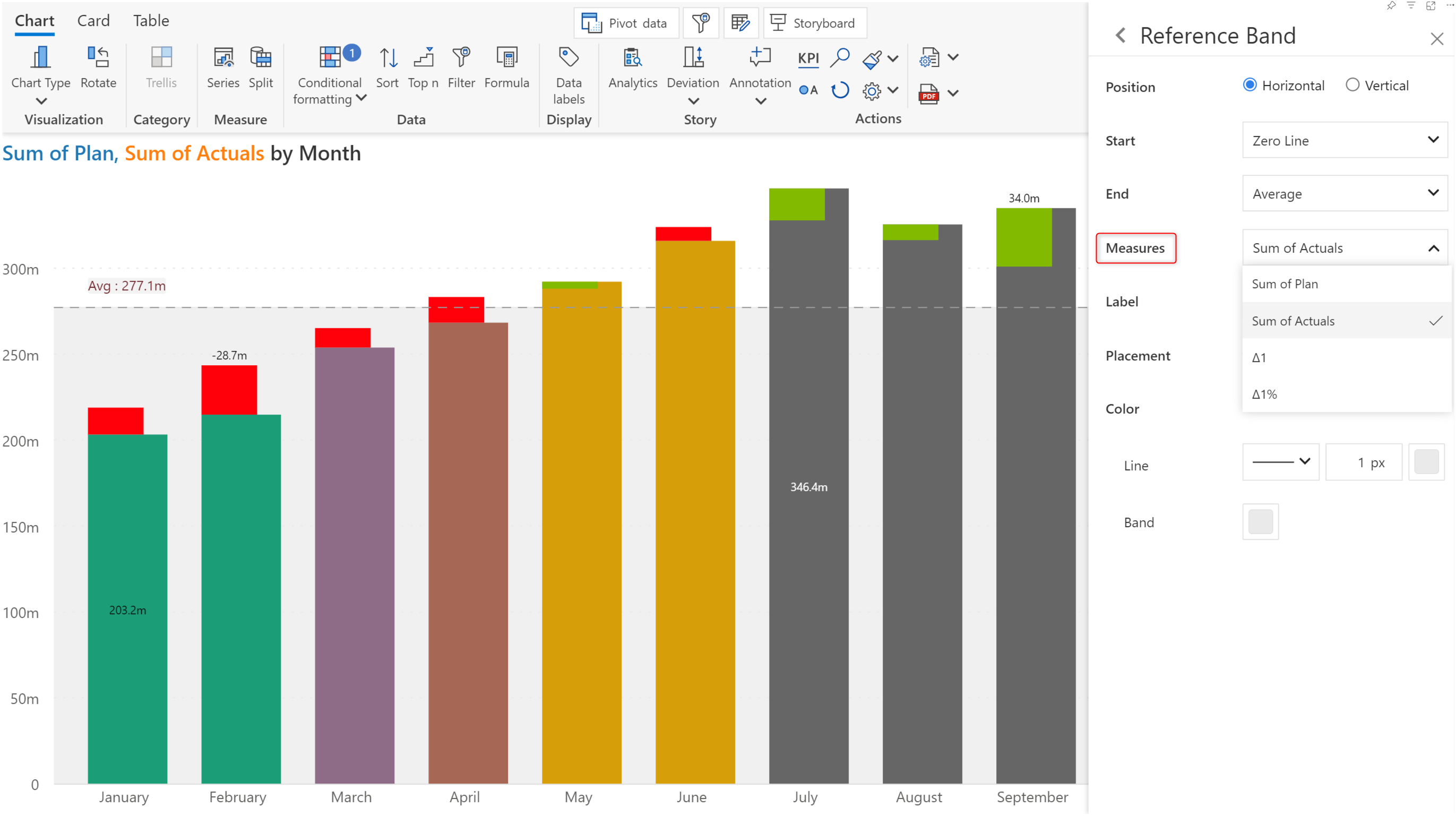
#### 4. Measures

Choose the measure values to plot the reference band. Reference bands can also be plotted based on the variance.

<figure><img src="/files/aHnDYAuLNnluctLpniy4" alt=""><figcaption><p>Measure to plot reference band</p></figcaption></figure>

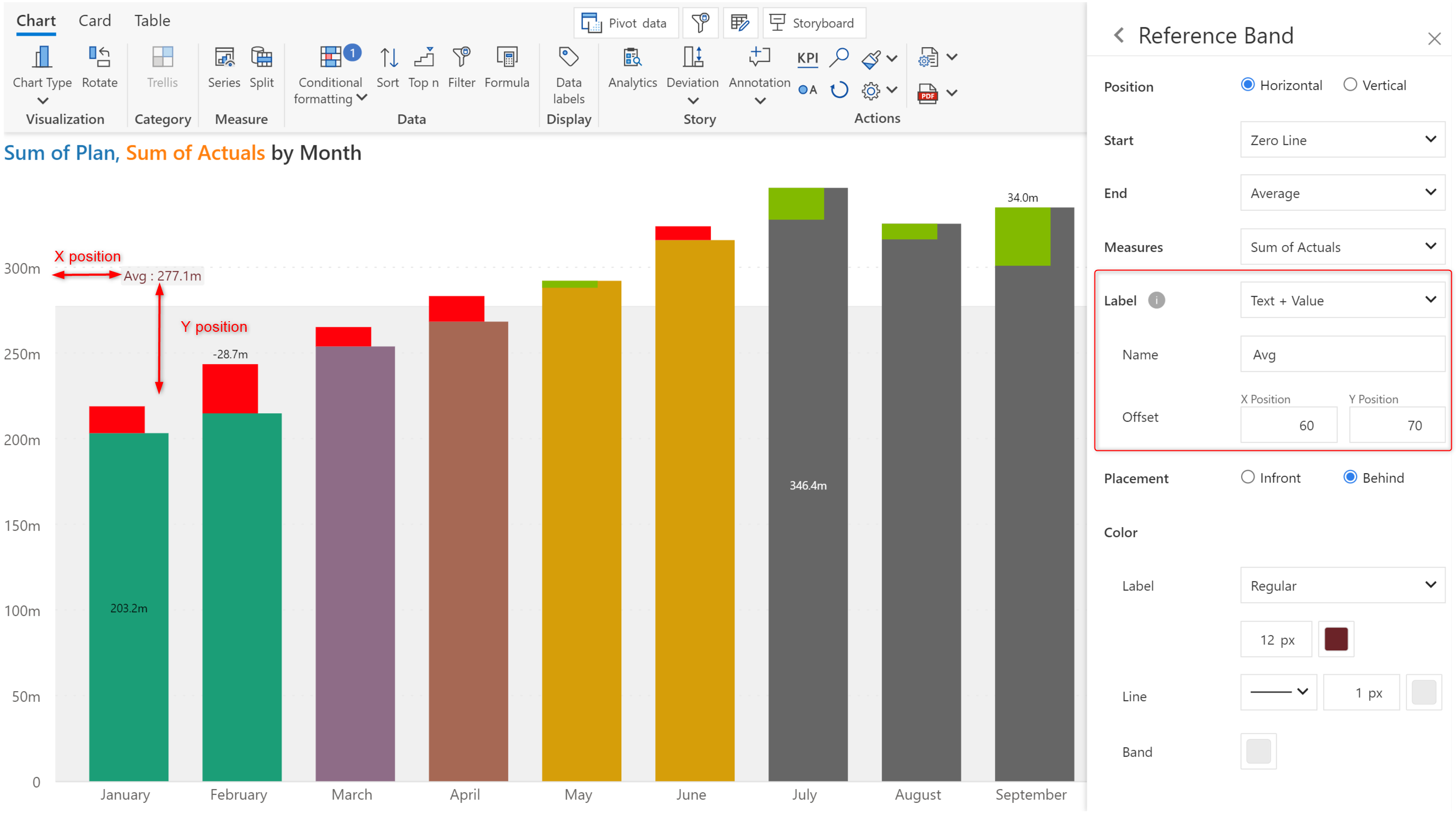
#### 5. Label

Display a label for the reference band. Display text, the end point value, or text along with the value.

* **Name:** The endpoint position is automatically used as the label name. You can specify a custom name if required.
* **Offset**: Specify the distance from the x-axis and y-axis to position the label.

<figure><img src="/files/fYFJdnH9dAiqHbqOvvJ6" alt=""><figcaption><p>Label customization</p></figcaption></figure>

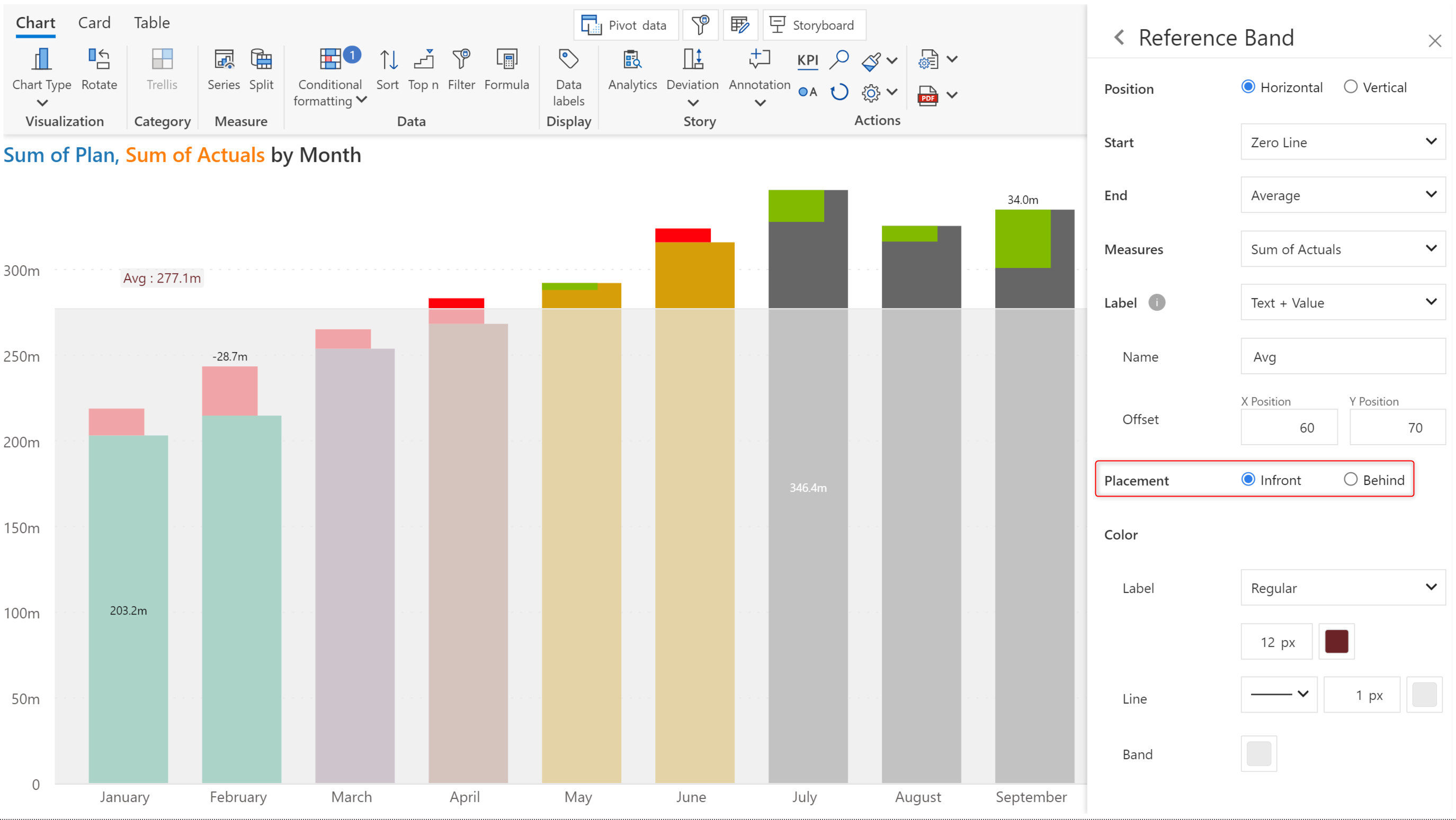
#### 6. Placement

The reference band is generally plotted behind the chart. You can also plot it in front as shown.

<figure><img src="/files/8pfkjvItyi8vmw9H0YI2" alt=""><figcaption><p>Reference band placement</p></figcaption></figure>

#### 7. Color

You can customize the label, band and band border.

* **Label**: Set the text style to Regular, Semi bold or bold. You can also set the label color and font size.
* **Line**: Choose from solid, dotted and dashed styles for the border lines. You can set the width and color.
* **Band**: Customize the color of the reference band.

<figure><img src="/files/o7L3yEid7SsxrZ5b0177" alt=""><figcaption><p>Additional customizations</p></figcaption></figure>

## Reference bands for time series data

When your dataset contains a time series, you can render reference bands for custom date ranges or the current week/month/year.

Select the **Timeseries** radio button as the Type option.

<figure><img src="/files/Sz5NP0e6T0yHF7Tb4Np6" alt=""><figcaption><p>Reference bands for time series data</p></figcaption></figure>


---

# Agent Instructions: Querying This Documentation

If you need additional information that is not directly available in this page, you can query the documentation dynamically by asking a question.

Perform an HTTP GET request on the current page URL with the `ask` query parameter:

```
GET https://docs.inforiver.com/analytics+/working-with-analytics+/19.-analytics/reference-band.md?ask=<question>
```

The question should be specific, self-contained, and written in natural language.
The response will contain a direct answer to the question and relevant excerpts and sources from the documentation.

Use this mechanism when the answer is not explicitly present in the current page, you need clarification or additional context, or you want to retrieve related documentation sections.