> For the complete documentation index, see [llms.txt](https://docs.inforiver.com/llms.txt). Markdown versions of documentation pages are available by appending `.md` to page URLs; this page is available as [Markdown](https://docs.inforiver.com/analytics+/working-with-analytics+/5.-tables.md).
# 5. Tables
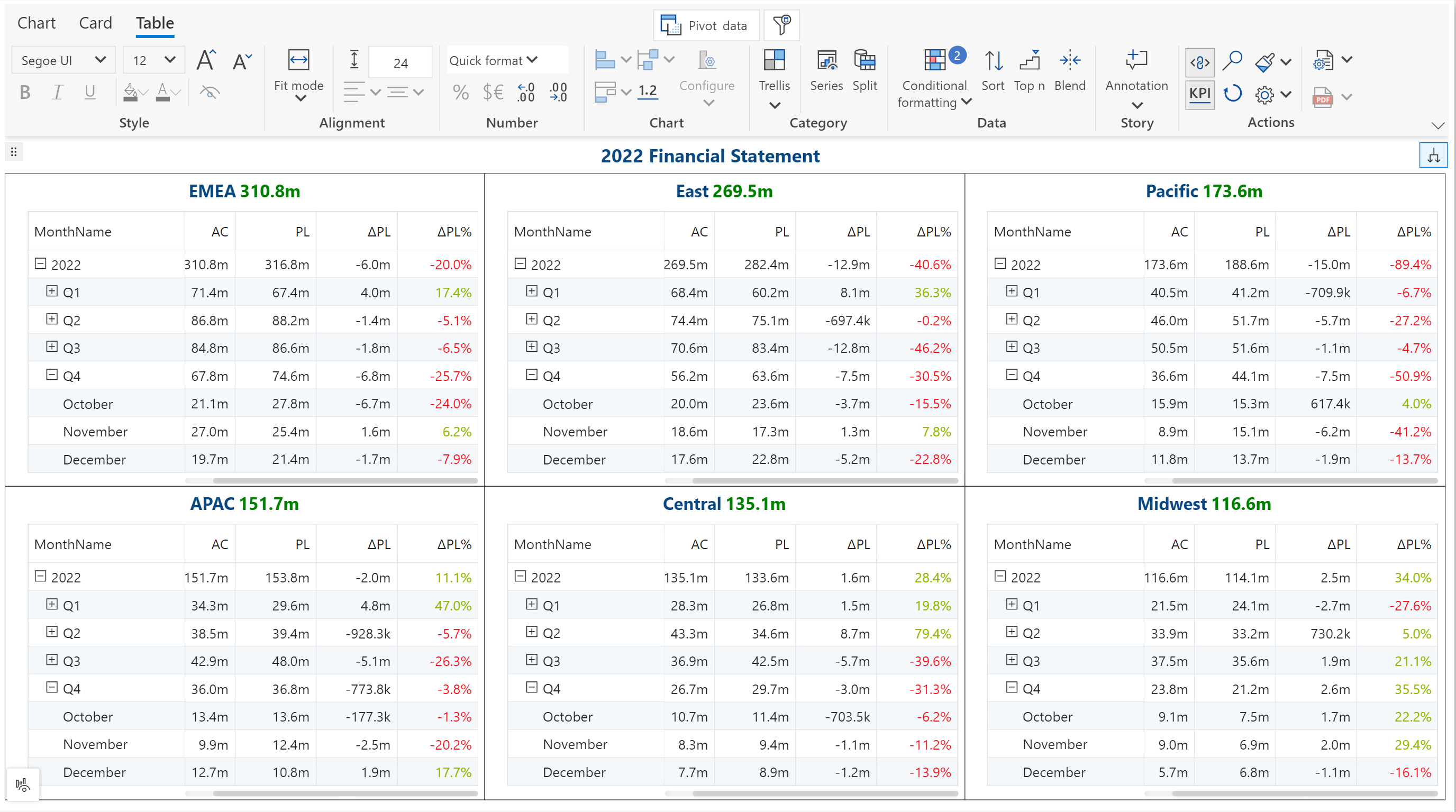
Inforiver's data table gives you an IBCS-compliant, multi-dimensional, tabular representation of your data in just a few clicks. Similar to the Inforiver Matrix, the data table also offers features like quick number formatting, cell-level annotations, ranking, and conditional formatting to name a few. The Analytics+ data table, however, has a game-changing feature - **small multiple tables**.
Small multiple tables
Small multiple tables are ideal for management reports or dashboards that require a high-level overview of your data. Analytics+ supports synchronized horizontal and vertical scrolling of panels - facilitating comparative analysis between dimensions.
### **When to use Inforiver Analytics+ Tables vs. Inforiver Matrix**
* For advanced use cases such as writeback, planning, what-if simulations, forecasting & budgeting, advanced formulae engine, formatted financial statements, paginated reports, threaded conversations, audit, data editing, scheduling, and notifications - use **Inforiver Matrix**.
* If you want to display tables in compact/IBCS tables with basic conditional formatting, integrated KPI card headers, sorting, Top N, and exports to PDF/Excel - go for **Analytics+**.
In the next sections, we'll explore how to leverage data tables to draw insights and identify patterns in your data.
---
# Agent Instructions
This documentation is published with GitBook. GitBook is the documentation platform designed so that both humans and AI agents can read, navigate, and reason over technical content effectively. Learn more at gitbook.com.
## Querying This Documentation
If you need additional information that is not directly available in this page, you can query the documentation by asking a question.
Perform an HTTP GET request on the following URL with the `ask` and `goal` query parameters:
```
GET https://docs.inforiver.com/analytics+/working-with-analytics+/5.-tables.md?ask=&goal=
```
`ask` is the immediate question: it should be specific, self-contained, and written in natural language.
`goal` is what the user is ultimately trying to achieve, the reason they need the answer. Sharing it helps GitBook give you a better, more relevant answer. A goal is most helpful when it describes the outcome the user wants rather than restating the question. For example, with `ask=how do I create an API token`, a goal like `automate deployments from our CI pipeline` lets GitBook tailor the answer to that use case.
The response will contain a direct answer to the question and relevant excerpts and sources from the documentation.
Use this mechanism when the answer is not explicitly present in the current page, you need clarification or additional context, or you want to retrieve related documentation sections.