# Sort & reorder data

Inforiver provides the standard sorting options - ascending/descending and A->Z/Z->A for numeric and non-numeric columns such as date, dropdown, text, and more. Custom sorting orders can also be created using the drag-and-drop reorder feature.

## 1. Sorting

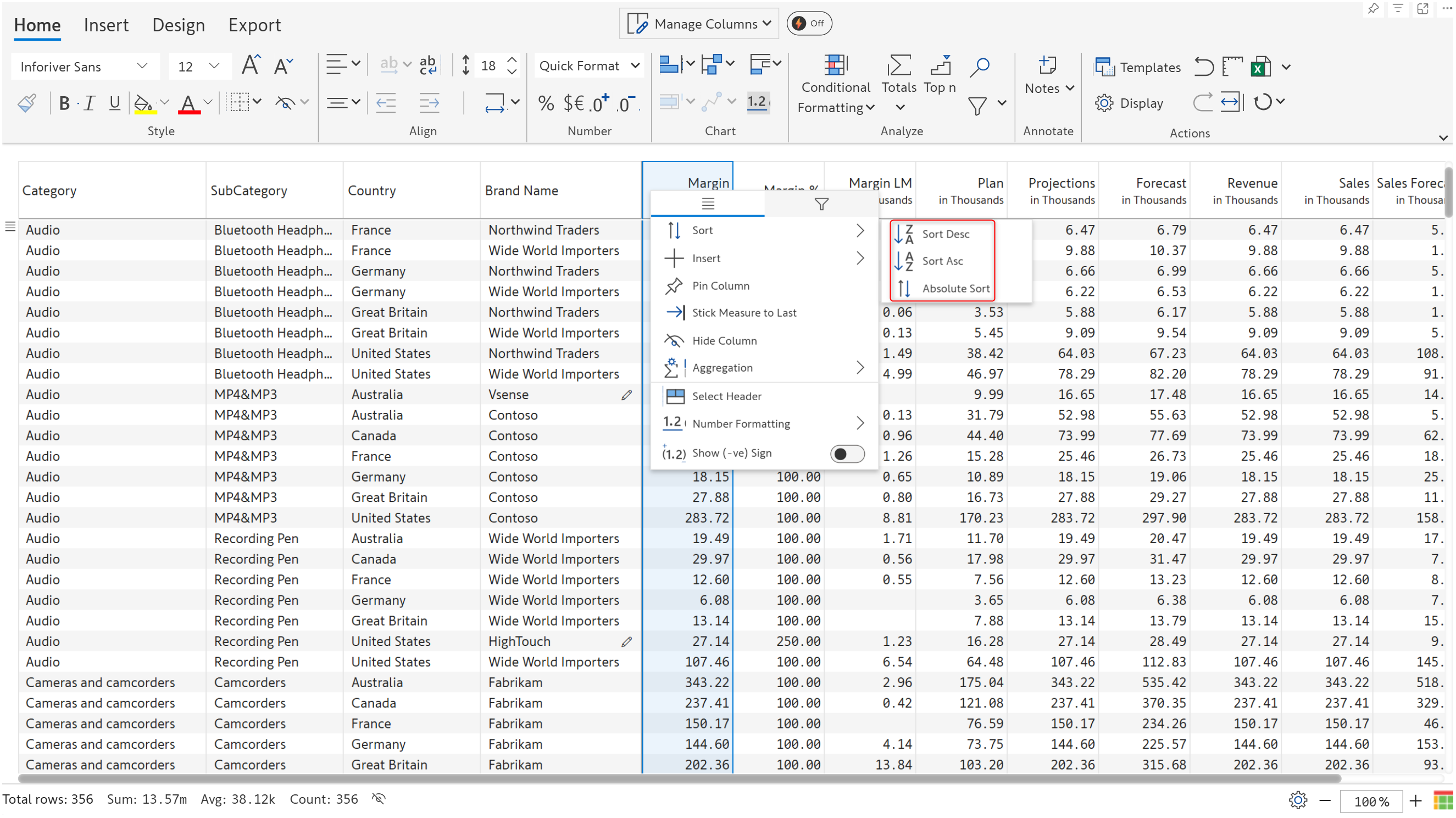
**1.1.** To sort a column by ascending or descending, hover over the column header and click on the gripper. Let's select Sort Desc.

<figure><img src="/files/bjqcQUrwp0O3WGvdS0l6" alt=""><figcaption><p>Sorting from the column gripper</p></figcaption></figure>

**1.2.** You can see that the Margin measure is sorted, and there is an icon to denote the descending sort.

<figure><img src="/files/VP69HoIyCZxDIiLtTNgQ" alt=""><figcaption><p>Margin measure sorted in descending order</p></figcaption></figure>

{% hint style="info" %}
To undo the sorting, click **Remove Sort** from the column gripper. Alternatively, you can click the sort icon in the header to remove the sort.
{% endhint %}

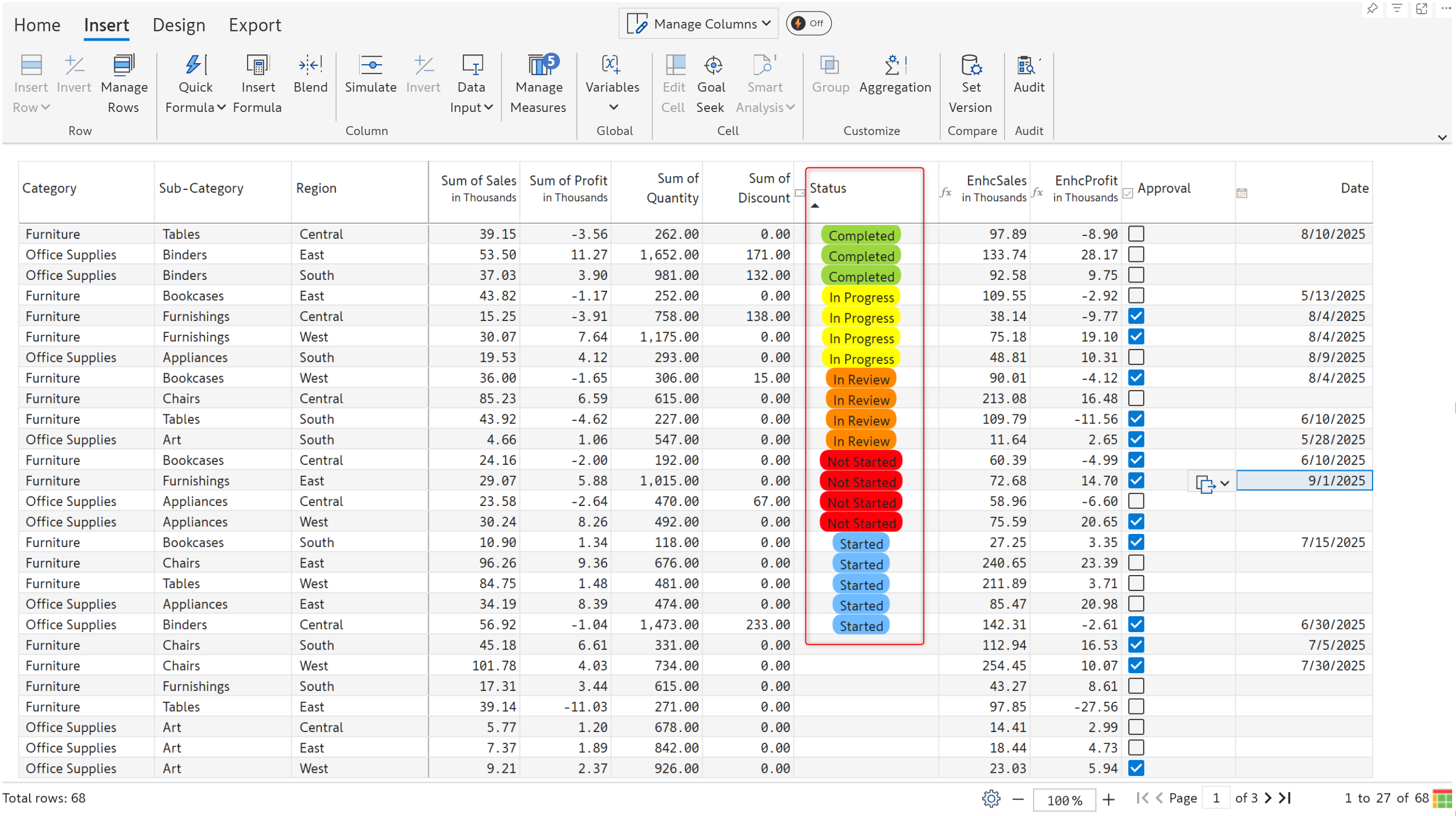
**1.3.** Similarly, sorting can also be applied to non-numeric columns. In a later section, we'll be covering how to insert data input columns such as text, dropdown, date, etc.&#x20;

<figure><img src="/files/Z5xRIaYjsHSDCmXN5jDj" alt=""><figcaption><p>Sorting non-numeric columns</p></figcaption></figure>

**1.4.** Notice that the dropdown column is sorted in ascending order.

<figure><img src="/files/Q6qaWoWX3CglH80mxiEu" alt=""><figcaption><p>Sorted data for non-numeric fields</p></figcaption></figure>

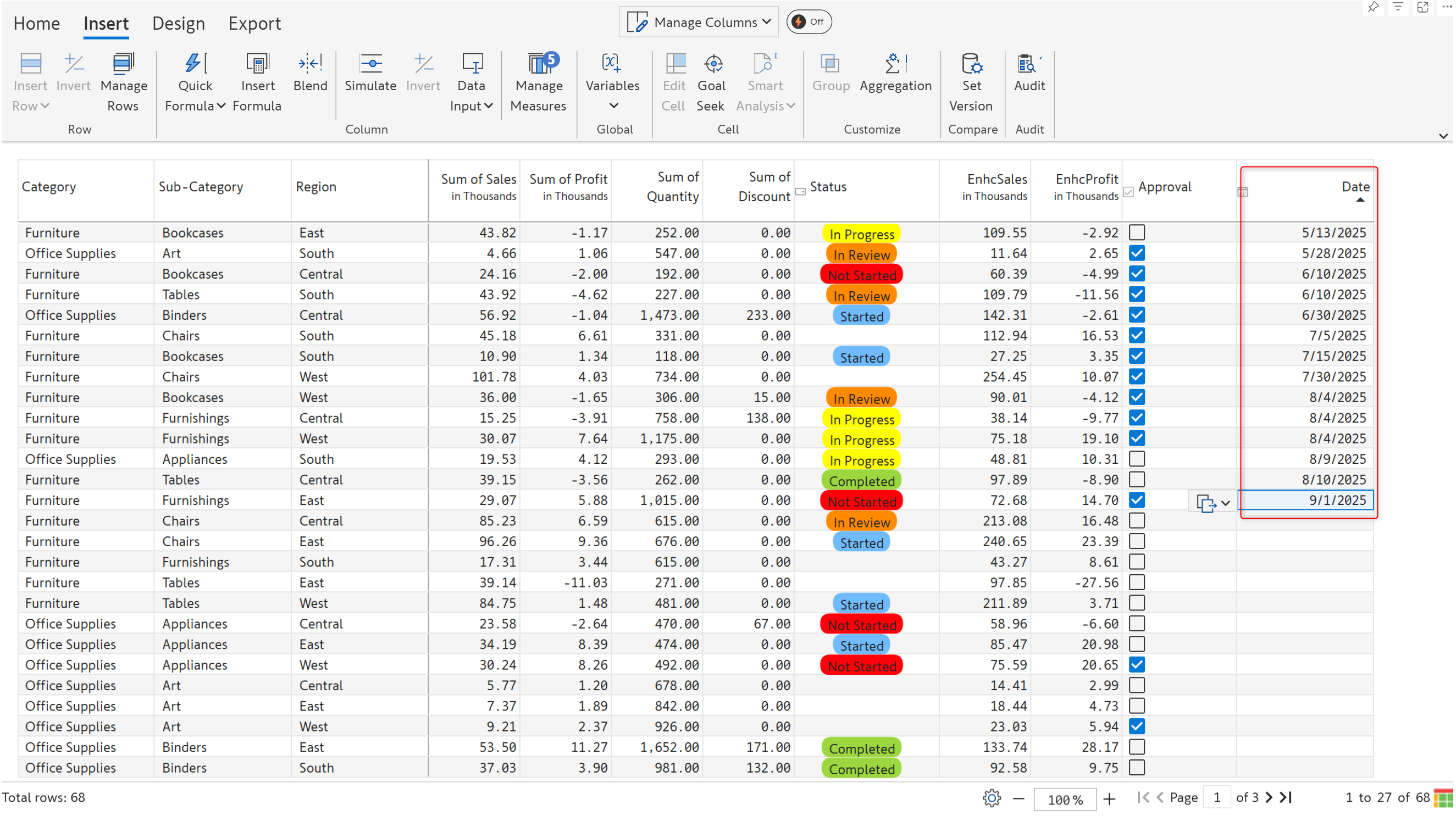
**1.5.** Sorting based on a date column is shown below.

<figure><img src="/files/BoYGyEt6mVTTY3I1XzZt" alt=""><figcaption><p>Sorting based on date field</p></figcaption></figure>

## 2. Reordering

With Inforiver, you can custom-sort rows/columns by simply dragging and dropping to order the categories the way you want.&#x20;

### 2.1. Rows&#x20;

When you hover over a row header, the row gripper is enabled. Click, hold, and move the gripper up or down to reorder.

<figure><img src="/files/uqGpTF83bQJ4GL1wvHMI" alt=""><figcaption><p>Reorder rows</p></figcaption></figure>

### 2.2. Columns

Similarly, you can reorder measures. Let's reorder the % variance.&#x20;

Click on the column gripper by hovering over the column header. Drag and drop to the required position. Notice how the measure is moved to the end of the report.

<figure><img src="/files/rWyDlkvu5oAPbSqksVCM" alt=""><figcaption><p>Reordering columns</p></figcaption></figure>

Another way to reorder measures is through the **Manage columns** dropdown. Hover over the measure you want to reorder - a hand icon appears. Drag and drop the measure to the desired position.

<figure><img src="/files/al2fGVOseLtG89w7kO3J" alt=""><figcaption><p>Re-ordering columns from Manage columns interface</p></figcaption></figure>

A third way to reorder measures is by clicking on the settings icon highlighted.

<figure><img src="/files/OGltsK1y1VUXmVqbMZww" alt=""><figcaption><p>Manage Column settings</p></figcaption></figure>

In the manage columns settings panel, click on the <img src="/files/B3NydoOb9Djg3oDT5U5R" alt="" data-size="line"> icon and drag to reorder.

<figure><img src="/files/QNALB7gh9Yvbo4xG87RL" alt=""><figcaption><p>Reordering measures from Manage Columns settings</p></figcaption></figure>

In the next section, we'll cover how to [show/hide values, rows, and columns](/premium-table/working-with-premium-table/3.-basic-interactions/show-or-hide-values-rows-and-columns.md).


---

# Agent Instructions: Querying This Documentation

If you need additional information that is not directly available in this page, you can query the documentation dynamically by asking a question.

Perform an HTTP GET request on the current page URL with the `ask` query parameter:

```
GET https://docs.inforiver.com/premium-table/working-with-premium-table/3.-basic-interactions/sort-and-reorder-data.md?ask=<question>
```

The question should be specific, self-contained, and written in natural language.
The response will contain a direct answer to the question and relevant excerpts and sources from the documentation.

Use this mechanism when the answer is not explicitly present in the current page, you need clarification or additional context, or you want to retrieve related documentation sections.