> For the complete documentation index, see [llms.txt](https://docs.inforiver.com/llms.txt). Markdown versions of documentation pages are available by appending `.md` to page URLs; this page is available as [Markdown](https://docs.inforiver.com/inforiver-enterprise-on-prem/deployment/microsoft-azure.md).
# Microsoft Azure
The following pages will guide you through the installation process of ‘Inforiver Add-on’ in your Azure subscription. The deployment process is straightforward as long as the instance details are valid and all software requirements are met before you begin.
{% hint style="danger" %}
### **Important!**
Make sure that you have completed all the sections from **Before You Start** and collected all the required credentials for the deployment.
{% endhint %}
### Checklist
Before proceeding further please verify whether you have the following details.
* [ ] Azure Subscriptions
* [ ] Azure Resource Group (New or Empty)
* [ ] Inforiver Designated Administrator User Principal Name
* [ ] All the domain names, that you want to allow users to login automatically for comments
* [ ] Azure AD Tenant ID
* [ ] Azure AD app Client ID
* [ ] Azure AD app Client Secret
* [ ] SMTP Host Address
* [ ] SMTP Port Number
* [ ] SMTP Username
* [ ] SMTP Password
* [ ] SMTP From Email Address
* [ ] Inforiver License Key
* [ ] Inforiver Docker Password
### Resource Creation
* Log in to [https://portal.azure.com](https://portal.azure.com/)
* Click on “Create a resource” from Azure services section.
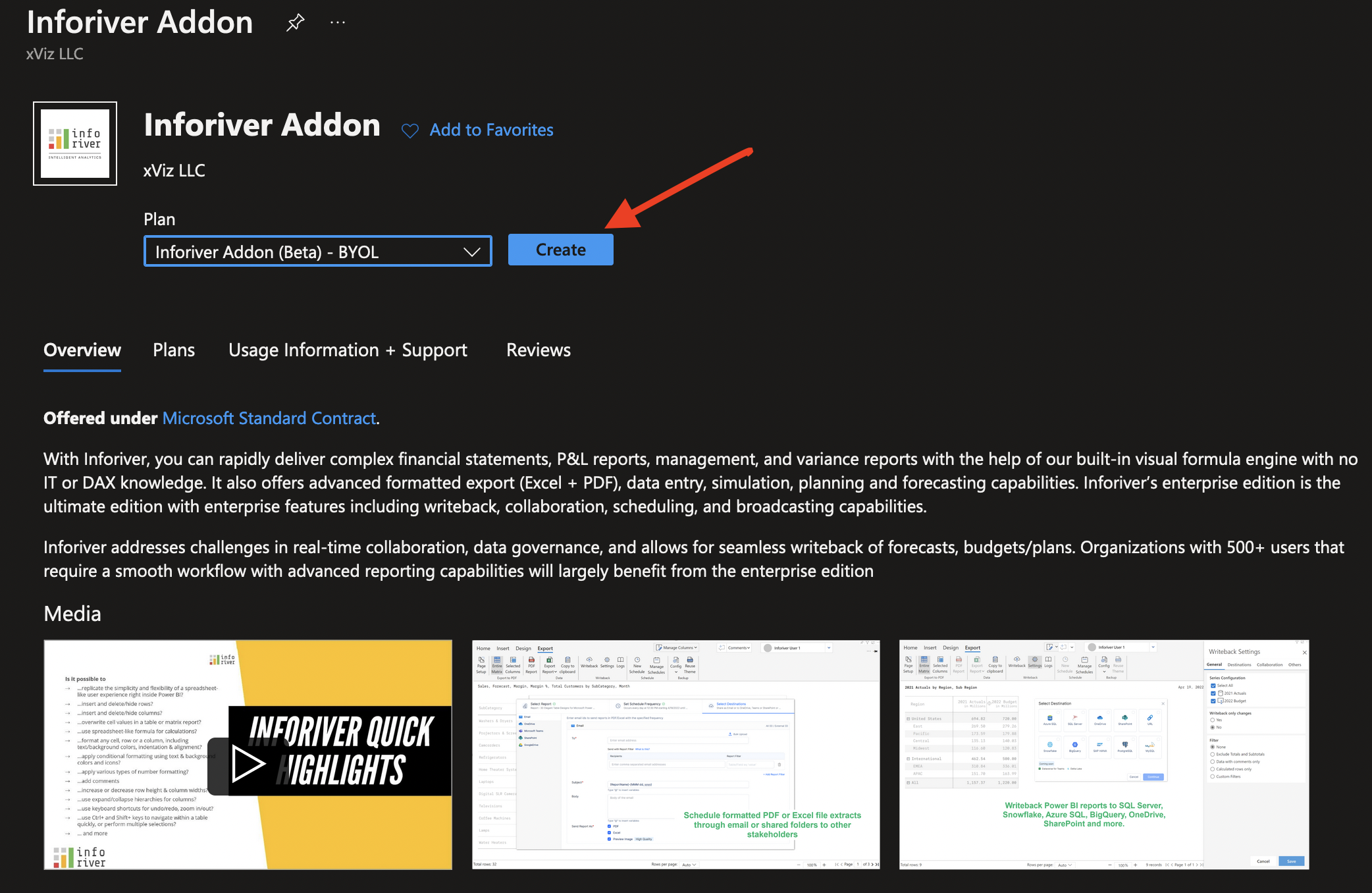
* Search for Inforiver Addon from Azure Marketplace
* Click on Create button
Resource Creation Page
Please proceed to the next pages to know about the deployment configuration.
---
# Agent Instructions
This documentation is published with GitBook. GitBook is the documentation platform designed so that both humans and AI agents can read, navigate, and reason over technical content effectively. Learn more at gitbook.com.
## Querying This Documentation
If you need additional information that is not directly available in this page, you can query the documentation by asking a question.
Perform an HTTP GET request on the following URL with the `ask` and `goal` query parameters:
```
GET https://docs.inforiver.com/inforiver-enterprise-on-prem/deployment/microsoft-azure.md?ask=&goal=
```
`ask` is the immediate question: it should be specific, self-contained, and written in natural language.
`goal` is what the user is ultimately trying to achieve, the reason they need the answer. Sharing it helps GitBook give you a better, more relevant answer. A goal is most helpful when it describes the outcome the user wants rather than restating the question. For example, with `ask=how do I create an API token`, a goal like `automate deployments from our CI pipeline` lets GitBook tailor the answer to that use case.
The response will contain a direct answer to the question and relevant excerpts and sources from the documentation.
Use this mechanism when the answer is not explicitly present in the current page, you need clarification or additional context, or you want to retrieve related documentation sections.