Waterfall Charts
Waterfall charts help visualize the cumulative impact of sequential values across a data series. Ideal for financial analysis, they make it easy to track changes in profit, revenue, cash flows, etc.
1. Single-category waterfalls
Chart Setup
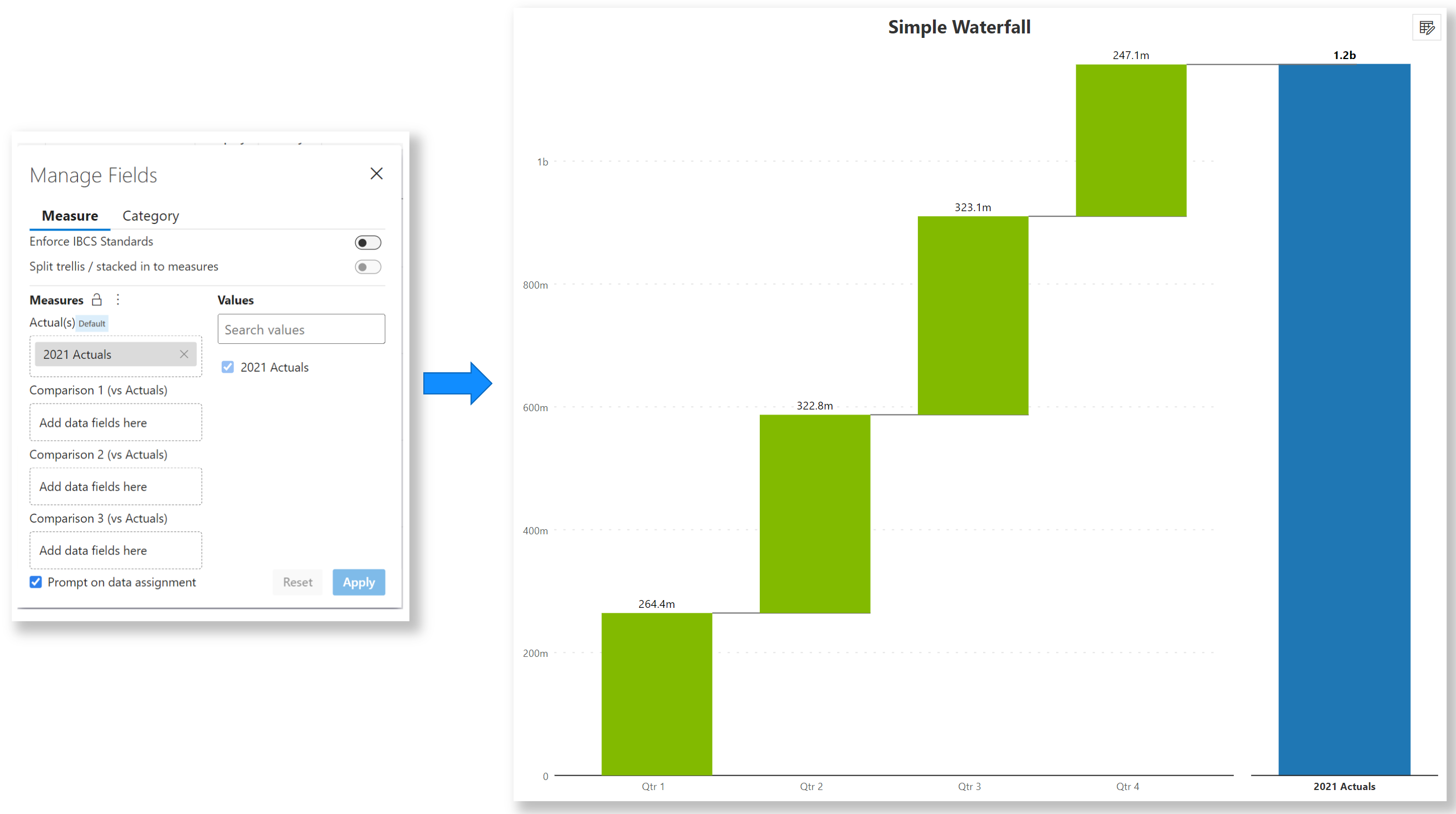
To build a simple waterfall:
Axis
- Drag the dimensions you want to use to break down and analyze the measures (e.g., Quarter).
Values parameter
- Drag multiple measures to analyze (e.g., 2021 Actuals).
Chart type
-Select Vertical Waterfall from the Waterfall section of the Chart Type dropdown menu.
The waterfall chart represents the contribution of each quarter to the final 2021 Actuals.

Chart Setup
To build a variance waterfall:
Axis
- Drag the dimensions you want to use to break down and analyze the measures (e.g., Quarter).
Values parameter
- Drag multiple measures to analyze (e.g., 2021 Actuals, 2020 Actuals).
Chart type
-Select Vertical Variance Waterfall from the Waterfall section of the Chart Type dropdown menu.
The waterfall chart represents the contribution of each quarter that led to the difference in Actuals between 2020 and 2021.

1. Other settings for variance waterfall charts
1.1. Variance datalabel format
Display the variance value, variance percentage, or both using this option.

1.2. Show variance inflations
Indicate whether the variance is positive or negative with arrow symbols.

Chart Setup
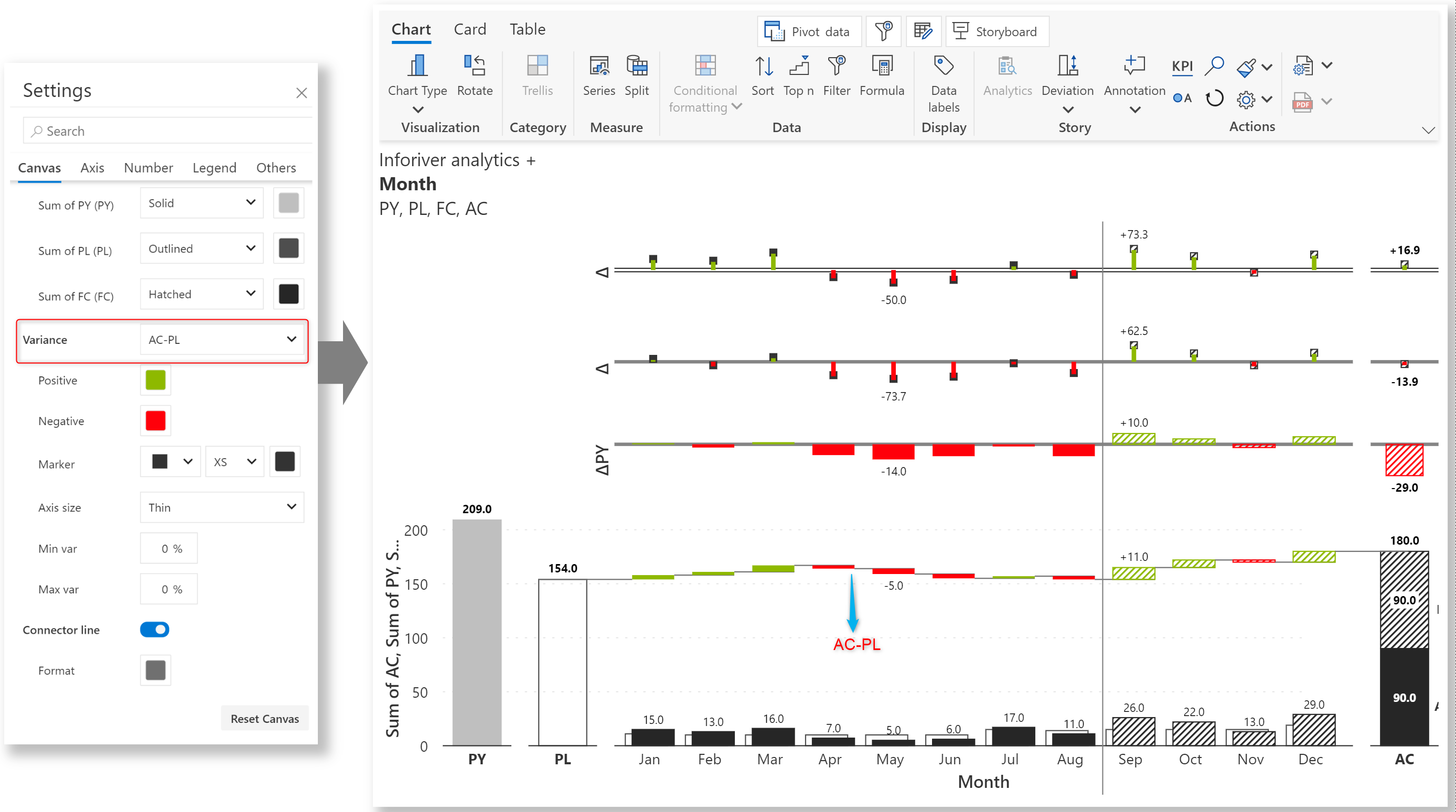
To build a combo waterfall:
Axis
- Drag the dimensions you want to use to break down and analyze the measures (e.g., Quarter).
Values parameter
- Drag multiple measures to analyze (e.g., 2021 Actuals, 2020 Actuals, 2021 Plan).
Chart type
-Select Waterfall + Column from the Waterfall section of the Chart Type dropdown menu.
The waterfall chart represents the variance between actuals and plan for 2021 and shows the difference between actuals, plan, and the previous year actuals.

When IBCS mode is enabled, this is the C05 IBCS equivalent chart.

1. Canvas settings for Waterfall + Column charts
1.1. Variance
Determine whether the variance waterfall should be plotted based on PY or PL.


2. Multi-category waterfalls
Chart Setup
To build a stacked waterfall:
Axis
- Drag the dimensions you want to use to break down and analyze the measures (e.g., Quarter).
Values parameter
- Drag multiple measures to analyze (e.g., 2021 Actuals).
Small Multiples
- Assign the dimension to use to plot the stacks (e.g., Sub Category)
Chart type
-Select Stacked Waterfall from the Waterfall section of the Chart Type dropdown menu.
The waterfall chart represents the contribution of each quarter to the total actuals. Within each quarter, the stacks capture the contribution of various product categories to that quarter.

1. Breakdown waterfall with small multiples
Chart Setup
To build a breakdown waterfall with small multiples:
Axis
- Drag the dimensions you want to use to break down and analyze the measures (e.g., Quarter).
Values parameter
- Drag multiple measures to analyze (e.g., Actuals).
Small Multiples
- Assign the dimension to use to further break down the measures (e.g., Sub Region)
Chart type
-Select Vertical Breakdown Waterfall from the Waterfall section of the Chart Type dropdown menu.
The waterfall charts breaks down the contribution of each quarter to the total Actuals. It also captures the contribution from different subregions to the change in actuals between consecutive quarters.

2. Measure-based Breakdown waterfall
Chart Setup
To build a measure-based breakdown waterfall:
Axis
- Drag the dimensions you want to use to break down and analyze the measures (e.g., Sub Region).
Values parameter
- Drag multiple measures to analyze (e.g., 2024 Actuals, 2023 Actuals, 2022 Actuals).
Chart type
-Select Vertical Breakdown Waterfall from the Waterfall section of the Chart Type dropdown menu.
Breaks down the contribution of each Sub Region to the total. It also captures the contribution of each measure to the change in totals between subregions.

Chart Setup
To build a stacked breakdown waterfall:
Axis
- Drag the dimensions you want to use to break down and analyze the measures (e.g., Quarter).
Values parameter
- Drag multiple measures to analyze (e.g., 2021 Actuals).
Small Multiples
- Assign a dimension to use to break down the measure and a second dimension to plot stacks (e.g., Sub Category, Region)
Chart type
-Select Vertical Breakdown Waterfall from the Waterfall section of the Chart Type dropdown menu.
Breaks down the contribution of each quarter to the total. It also captures the contribution from different regions to the change in actuals between consecutive quarters. Additionally, the stacks show the contribution of each product category to the actual value for a particular quarter.

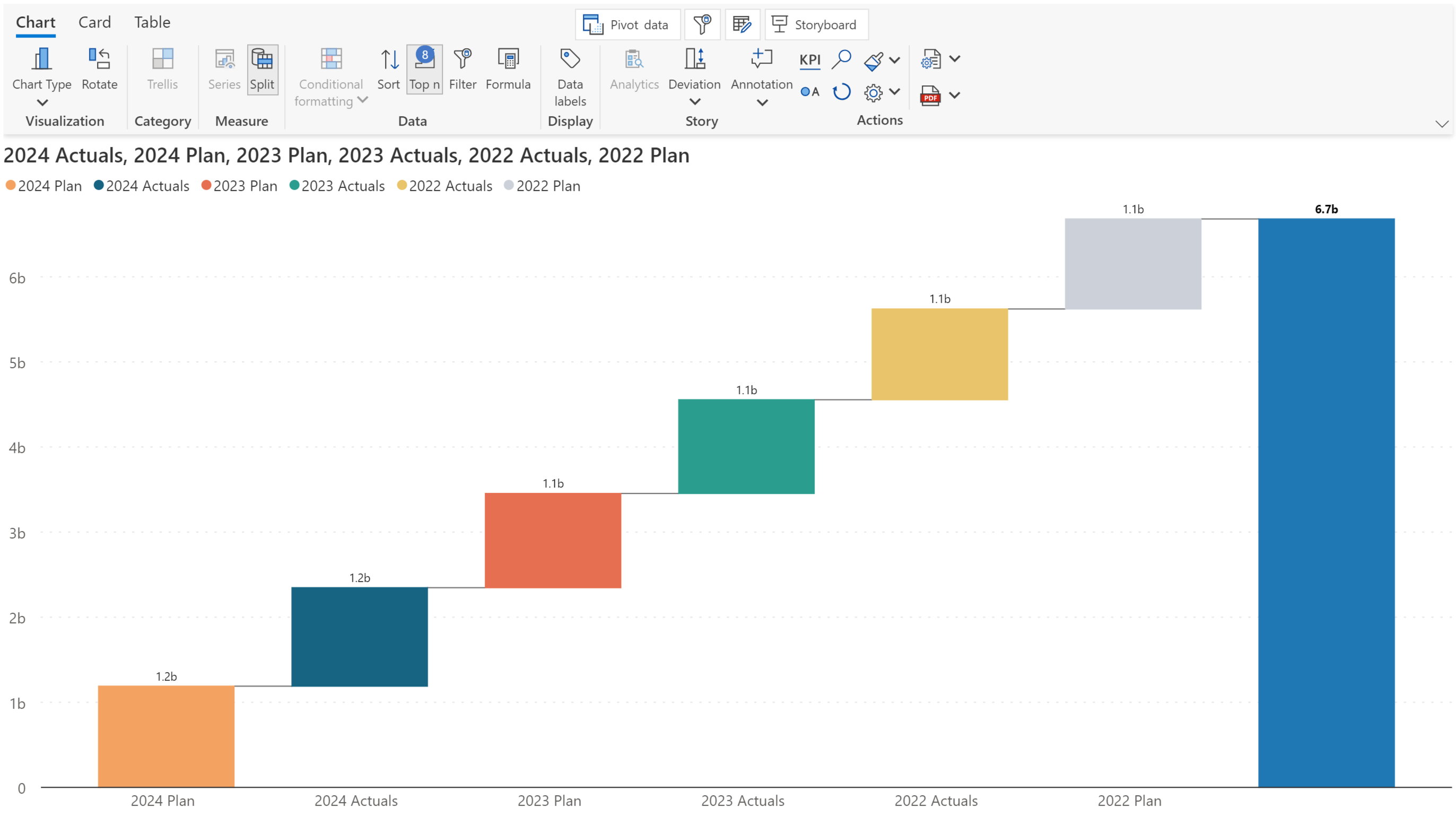
3. Single-measure, no-category waterfall
Chart Setup
To build a single measure waterfall:
Axis
- Does not require an axis parameter.
Values parameter
- Drag multiple measures to analyze (e.g., 2024 Actuals, 2024 Plan, 2023 Actuals, 2023 Plan, 2022 Actuals, 2022 Plan).
Chart type
-Select Vertical Breakdown Waterfall from the Waterfall section of the Chart Type dropdown menu.
The waterfall chart breaks down the contribution of each measure to the total. Does not require an explicit measure or dimension configuration.

Additional formatting options
Here are the other settings that help you refine your waterfall chart.
Migrating from xViz Waterfall charts to Analytics+
Download Guide and Demo
Access the detailed guide with step-by-step settings paths and a PBIX demo report for comprehensive configuration examples between xViz and Analytics+.
Download ↓
Last updated
Was this helpful?