> For the complete documentation index, see [llms.txt](https://docs.inforiver.com/llms.txt). Markdown versions of documentation pages are available by appending `.md` to page URLs; this page is available as [Markdown](https://docs.inforiver.com/formula-syntax/math-functions/sort.md).
# SORT
Sorts a series of values in ascending order and returns them as an array for easy ranking and analysis.
The SORT function accepts a series of values and returns them as an array sorted in ascending order. It organizes the input numbers from the smallest to the largest, allowing individual elements to be accessed using their index positions. The function is useful for analyzing ranked data, identifying minimum or maximum values, and performing comparisons after ordering the dataset.
### Syntax
```javascript
SORT(value1,[value2]...)
```
### Arguments
value1,\[value2] – A series of numerical values to be sorted (Required).
### Example
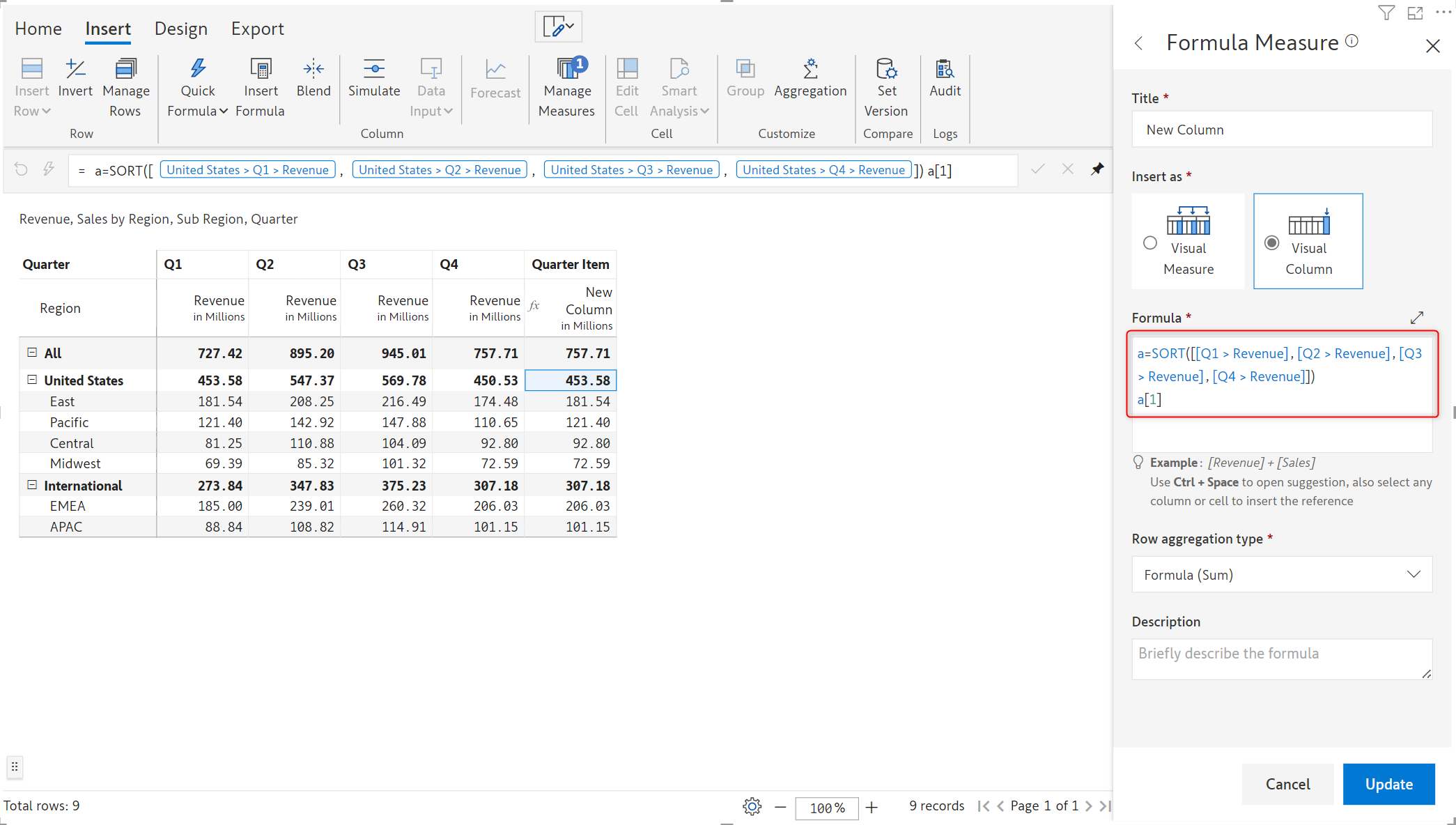
Consider that we are analyzing quarterly revenue. We need to determine the least but one revenue amount. In order to achieve this, we can use the sort function to sort the quarterly revenue for each row in ascending order. The sort function returns an array, we can access the elements using their index as shown in the image below.
Application of SORT function
In the example above, the variable 'a' holds the resulting array from the sort function. We can then access the least quarterly revenue element using the index a\[0] and the highest quarterly revenue using a\[3].
{% hint style="info" %}
To sort in descending order use the SORTDESC function.
{% endhint %}
---
# Agent Instructions
This documentation is published with GitBook. GitBook is the documentation platform designed so that both humans and AI agents can read, navigate, and reason over technical content effectively. Learn more at gitbook.com.
## Querying This Documentation
If you need additional information that is not directly available in this page, you can query the documentation dynamically by asking a question.
Perform an HTTP GET request on the current page URL with the `ask` query parameter, and the optional `goal` query parameter:
```
GET https://docs.inforiver.com/formula-syntax/math-functions/sort.md?ask=&goal=
```
`ask` is the immediate question: it should be specific, self-contained, and written in natural language.
`goal` is optional and describes the broader end goal you are ultimately trying to accomplish on behalf of the user. GitBook uses it to tailor the answer towards what is most useful for that goal.
The response will contain a direct answer to the question and relevant excerpts and sources from the documentation.
Use this mechanism when the answer is not explicitly present in the current page, you need clarification or additional context, or you want to retrieve related documentation sections.